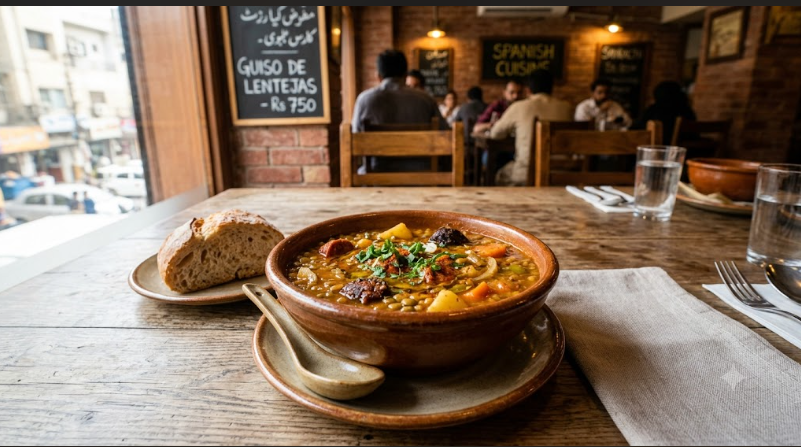
You open your phone, type “best guiso de lentejas near me,” and expect a simple answer: one or two nearby restaurants serving a rich, slow-cooked lentil stew. What you usually get instead is a mix of Latin restaurants, Mexican grills, and Mediterranean spots that don’t actually list the dish you’re craving.
That gap between search intent and real-world menus is the core of this topic. Guiso de lentejas isn’t just a dish name. It’s a specific style of cooking that changes depending on country, chef, and tradition. In the US, and especially in smaller cities and suburbs, it rarely appears under that exact label. So the real challenge isn’t finding the name. It’s finding the experience.
This guide breaks down what guiso de lentejas actually is, why it’s hard to find nearby, what restaurants typically serve something similar, and how to order smart so you still get that same comforting bowl even when it’s not listed on the menu.
What guiso de lentejas actually means
Guiso de lentejas is a traditional lentil stew found across Latin America, especially associated with Argentine home cooking. It is thick, hearty, and usually slow-cooked with vegetables like onions, carrots, and potatoes. In many versions, it also includes beef, sausage, or smoked meat for depth. Unlike thin lentil soup, guiso is meant to be filling enough to stand as a full meal. The texture is richer, the flavor is deeper, and the cooking method is slower. That slow simmer is what gives it its identity.
Here’s where it gets interesting. The dish changes depending on region. In Argentina, it often feels like winter comfort food. In other Latin countries, lentil stews may be lighter, spicier, or mixed with rice. So even if two restaurants serve “lentils,” they may not be serving the same dish at all. That variation is one reason why you rarely see guiso de lentejas written clearly on US menus.
Why you can’t easily find it “near me”
If you live in places like Northern Virginia, Maryland suburbs, or most US cities outside major Latin hubs, guiso de lentejas is not usually a fixed menu item. Restaurants tend to simplify menus for broader audiences, and traditional home-style dishes often get grouped into general categories like “soup of the day” or “house stew.”
Another issue is consistency. Guiso is not a fast-cooking dish. It takes time, planning, and often low demand to justify keeping it on a permanent menu. Many restaurants only prepare it occasionally or during colder seasons There’s a catch, though. Even when restaurants don’t list it, many still know how to make it. It just exists behind the menu, not on it. So when people search “best guiso de lentejas near me,” they’re usually not looking for a named listing. They’re looking for a restaurant that still cooks real, slow Latin comfort food.
What kind of restaurants actually serve it
To find guiso de lentejas or something close to it, you need to think in terms of cuisine type rather than dish name.
The most likely places are:
- Argentine restaurants
- Peruvian home-style kitchens
- Salvadoran or Central American family restaurants
- Spanish tapas-style eateries
- Some Mexican restaurants with rotating specials
These kitchens are more likely to prepare lentils as part of traditional cooking rather than standardized menu items. But here’s the reality: even in these places, availability depends on the day. Guiso de lentejas is often a “chef’s decision” dish rather than a permanent offering. That means your success depends less on Google and more on asking the right questions when you arrive.
What to order when guiso de lentejas is not listed
If you walk into a restaurant and don’t see guiso de lentejas, you still have options. In fact, most people end up eating something very similar without realizing it.
Look for these alternatives:
- Lentil soup (sopa de lentejas) is the closest direct substitute. It may be lighter, but the base flavor is often similar.
- Bean stews (frijoles or habichuelas guisadas) offer a similar comfort profile with a different legume base.
- House stews or daily specials often rotate and can include slow-cooked dishes that feel very close to guiso.
- Rice and lentil combinations are also common in Latin cooking and can deliver a similar texture experience.
- So what does this mean in practice? You’re not chasing a single dish name. You’re chasing a cooking style: slow, seasoned, and comforting.
How to actually find guiso de lentejas near you
The most effective approach is not scrolling through menus. It’s interacting directly with restaurants. Start with Latin American restaurants in your area. Once you’re there, ask a simple question: “Do you ever make lentil stew or lentejas today?” This matters because many kitchens rotate dishes daily based on ingredients and demand. What is missing online may be sitting in the kitchen that day.
Timing also matters. Lunch hours tend to have more rotating specials compared to dinner menus, which are often fixed. There’s also a local pattern worth noticing. Restaurants in suburban areas near major cities often serve more traditional dishes than fast-casual chains, even if those dishes are not advertised.
Why guiso de lentejas is rarely standardized in the US
One of the biggest misunderstandings is assuming that traditional dishes will appear consistently across restaurants in the US the same way they do in their countries of origin. In reality, US restaurant menus are shaped by demand, cost control, and kitchen efficiency. Dishes that require long cooking times and low turnover often get simplified or removed.
Guiso de lentejas falls into that category. It’s not difficult to make, but it doesn’t fit fast-service models. That is why it survives mostly in home cooking, rotating specials, or restaurants that prioritize traditional recipes. Not everyone agrees with this shift. Some chefs continue to keep traditional stews alive even when they are not the most profitable items. But they are fewer than most people expect.
What a good version should taste like
A proper guiso de lentejas should feel thick without being heavy. The lentils should be soft but not broken down into paste. The flavor should be layered, starting with sweetness from vegetables and finishing with savory depth from slow cooking. If meat is included, it should not overpower the dish. Instead, it should blend into the stew and enhance the broth. Texture matters just as much as taste. A good version holds its shape on a spoon without being watery. If what you’re eating feels like thin soup with lentils floating inside, it’s closer to lentil soup than guiso.
What to realistically expect near you
If you’re searching in most US suburban areas, including places like Northern Virginia, you should expect three outcomes:
You may find restaurants that serve lentil soup regularly.
- You may find rotating specials that occasionally include lentil stew.
- Or you may need to settle for similar dishes that capture the same comfort profile.
- That doesn’t mean the experience is missing. It just means it is distributed across different menu categories.
Conclusion
Finding the “best guiso de lentejas near me” is less about locating a specific restaurant and more about understanding how the dish exists in local food culture. It is not usually a fixed menu item in most US restaurants. Instead, it appears as a rotating dish, a home-style special, or a close variation under a different name.
Once you shift your expectation from exact naming to cooking style, your options expand significantly. Latin American restaurants, especially those focused on traditional cooking, are your best chance of finding something close. The real value of guiso de lentejas is not just the ingredients. It is the slow-cooked comfort behind it. And that experience, even when labeled differently, is still very much within reach.