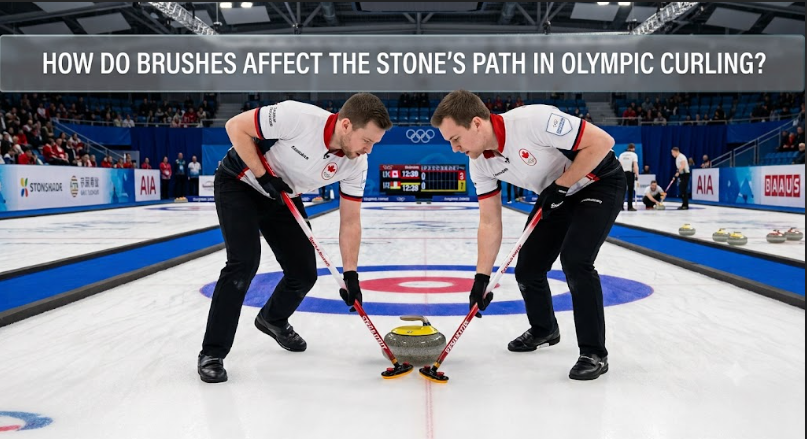
Curling looks simple until you actually pay attention to the movement of the stone. A heavy granite rock slides across ice, sweepers move their brushes rapidly in front of it, and somehow the path changes in real time. To most viewers, it feels like the broom is “guiding” the stone. But that’s not what’s happening.
The truth is more subtle and far more interesting. Brushes don’t steer the stone. They change the surface the stone is traveling over. And in a sport where millimeters decide outcomes, that small change in surface conditions becomes powerful enough to reshape speed, distance, and even the curve of the shot. To understand this properly, you need to think less about force and more about friction, heat, and timing. That’s where the real control in curling lives.
The moment the stone hits the ice, the system is already in motion
A curling shot begins with a single release. The player pushes the stone and gives it a slight rotation. From that instant, the stone is on its own trajectory. There is no engine, no steering mechanism, and no external push after release. The stone’s behavior is determined by three main things: its initial speed, its spin, and the condition of the ice.
What sweepers do happens entirely within that third factor. They don’t touch the stone. They don’t push it forward. Instead, they work on the ice directly in front of its path, shaping how the surface will interact with the stone in the next second of motion. That small time window is everything.
Ice in curling is not smooth — and that matters more than people think
Curling ice is intentionally prepared with a textured surface. This texture is created by spraying tiny droplets of water that freeze into small bumps. Players call this “pebbling.” These pebbles are not decorative. They create controlled friction between the stone and the ice. As the stone moves, it constantly interacts with these frozen droplets. Without sweeping, the stone bumps across these irregularities, losing energy more quickly and following a more pronounced curved path based on its rotation.
So when a stone travels naturally, two things happen at once:
- It slows down due to friction
- It gradually curls because of uneven surface interaction
Sweeping is designed to influence both of these behaviors.
What sweeping actually does to the ice surface
When sweepers move their brushes rapidly back and forth, they are doing more than just brushing away snow. The motion creates friction between the broom and the ice. That friction generates heat. That heat slightly alters the top layer of the pebbled surface. It doesn’t melt the ice into visible water. Instead, it creates a microscopic layer of softened moisture that changes how the stone interacts with the surface.
This thin layer acts like a temporary lubricant. So instead of the stone bouncing over rough, dry peaks of ice, it glides over a smoother interface. That changes everything about how it moves. But here’s the key idea: sweeping doesn’t add energy. It reduces resistance.
Why the stone appears to “speed up” during sweeping
One of the most common misunderstandings in curling is the idea that sweeping makes the stone faster. It doesn’t. What actually happens is that the stone loses less speed than it normally would. On unswept ice, friction steadily drains energy from the stone. On swept ice, that energy loss slows down.
So when viewers see sweeping happening, they often notice the stone traveling farther than expected. It looks like acceleration, but it’s really just reduced deceleration. That distinction matters because it explains why sweeping is most effective early in the stone’s travel. At higher speeds, small reductions in friction have a bigger impact on final distance.
How brushes influence the curl of the stone
The curling motion is what gives the sport its name. A spinning stone does not travel in a straight line. It gradually bends across the ice. This curve happens because of asymmetry in friction. As the stone rotates, one side interacts with the ice slightly differently than the other. Over distance, that imbalance creates a sideways deviation.
Sweeping reduces the strength of that interaction. When friction is lowered, the stone has less grip on the ice surface. That means the sideways forces that create curl become weaker. The result is a straighter path. But it’s not an on/off switch. The stone still curls. Sweeping only reduces how sharply it bends. So sweepers are not eliminating curve. They are controlling how much curve is allowed to develop before the stone reaches its target.
Timing is the real skill behind sweeping
Sweeping is not constant. It is carefully timed, and that timing changes its effect. Early sweeping mainly affects distance. At this stage, the stone is still moving quickly, so reducing friction has a strong effect on how far it will travel.
Late sweeping is more about line control. As the stone slows down, it becomes more sensitive to small changes in surface interaction. A few seconds of sweeping near the end of the shot can determine whether the stone finishes inside or outside the target area. This is why sweepers communicate constantly with the skip. They are reacting in real time to speed, direction, and ice behavior. The decision to sweep or stop sweeping can be just as important as the throw itself.
Do brushes steer the stone?
This is where curling gets misunderstood the most. Brushes do not steer the stone in a directional sense. They don’t push it left or right. They don’t apply sideways force that changes its trajectory like a hand guiding a ball. Instead, they change the conditions of the surface ahead of the stone. The stone then responds naturally to those conditions.
A better way to think about it is this: sweepers are not drivers. They are road condition managers. They are not turning the vehicle. They are smoothing or roughening the road in front of it. That difference explains why sweeping is so powerful without being direct.
Why sweeping is so strategically important in Olympic curling
At elite level, curling is decided by extremely small differences. A shot might miss by centimeters. That is why sweeping is treated as a core skill, not a supporting action.
Sweepers are constantly judging:
- how fast the stone is slowing down
- how much curl is developing
- how much distance is still needed
They then adjust sweeping intensity accordingly.
In many cases, the outcome of a shot depends on whether sweepers commit early or hold back. That decision is often made in seconds, based on communication from the skip and their own reading of the ice. This is where curling becomes more than physics. It becomes coordination under pressure.
Common misunderstandings about sweeping
One common belief is that sweeping pushes the stone forward. It does not. There is no forward force added. Another misconception is that sweeping fully controls direction. It doesn’t. The stone’s direction is still primarily determined by the initial release and rotation.
A third misunderstanding is that sweeping always has the same effect. In reality, ice conditions, temperature, and timing all change how effective sweeping is in any given moment. Curling is not mechanical. It is responsive.
Conclusion
Brushes in Olympic curling don’t act like steering tools or engines. They act on something much more subtle: the relationship between stone and ice. By slightly warming and smoothing the surface ahead of the stone, sweepers reduce friction. That reduction changes how far the stone travels and how sharply it curls. The result is a system where tiny surface adjustments produce large competitive consequences. What looks like simple broomwork is actually real-time control over physics. And in a sport decided by inches, that control is everything.