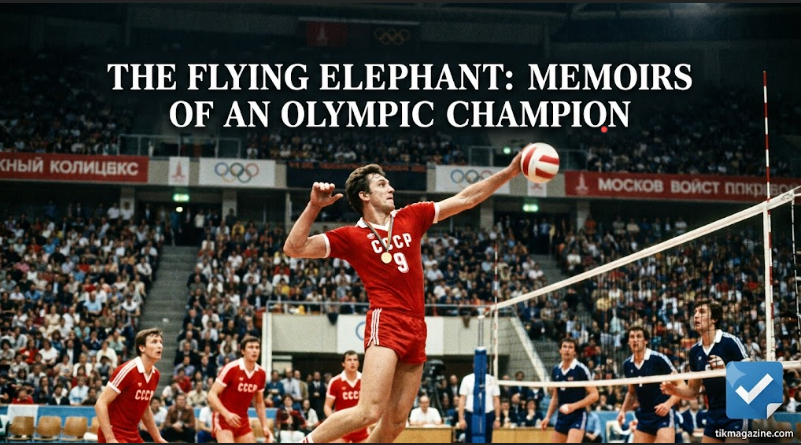
The first thing that catches attention about The Flying Elephant: Memoirs of an Olympic Champion is not the athlete’s name or even the Olympic reference. It is the title itself. A flying elephant is not something the mind accepts easily. It feels impossible, almost playful, yet deliberately chosen. That tension sets the tone for the entire memoir associated with Alexander Savin, the 1980 Olympic volleyball champion, whose career is rooted in one of the most disciplined sporting systems in modern history.
For readers searching this book, the question is rarely just “what is it about?” More often, it is: Is this real? Who is Alexander Savin? And what kind of Olympic story does this represent? The answers sit somewhere between sports history, personal reflection, and the structured world of Soviet-era athletics. This is not just a story about winning medals. It is a story about how champions are formed inside systems where excellence is expected, not optional.
The athlete behind the memoir
Alexander Savin is presented as a former Soviet volleyball player who reached the peak of his sport at the 1980 Moscow Olympic Games, where he became part of a gold-medal-winning team. That achievement alone places him among the elite athletes of his generation, but the memoir framing suggests his story is not limited to a single event.
Instead, it reflects a career shaped by long-term discipline, structured training, and participation in one of the most competitive volleyball environments of the time. Soviet sports during this era were known for producing athletes through centralized systems, where talent identification and development were highly organized and intensely demanding. Savin’s voice in this memoir is often described as reflective rather than celebratory. The focus is not only on what was won, but on what was required to reach that level in the first place.
Inside a system built for performance
To understand this memoir, it is important to understand the world it comes from. Soviet volleyball was not simply a sport played at club level. It was part of a national system designed to produce international dominance. Athletes were trained in structured environments where repetition, physical conditioning, and tactical discipline were central. Clubs like CSKA Moscow played a key role in shaping elite players, acting as both training grounds and pipelines to national team selection.
In such a system, performance was not treated as occasional success. It was treated as a continuous requirement. Athletes were expected to maintain peak condition over long periods, often under strict coaching supervision and intense internal competition. The memoir, as it is commonly described, reflects this reality. It does not romanticize training. It presents it as routine, demanding, and sometimes emotionally heavy. That tone sets it apart from typical sports storytelling that focuses mainly on victories and highlights.
The 1980 Olympic backdrop
The 1980 Moscow Olympics form the most recognizable anchor point in Savin’s career. This was a moment when sport and global politics were deeply connected, and athletes competed under more than just sporting pressure. For Soviet athletes, the home Olympics carried symbolic weight. Success was tied to national pride, institutional reputation, and global perception. Volleyball, as one of the USSR’s strong disciplines, became part of that larger narrative.
Within the memoir framework, this Olympic moment is not presented as an isolated achievement. It is instead part of a long preparation cycle, where years of training converge into a few decisive matches. What stands out is the sense that victory is not portrayed as surprise or breakthrough, but as the expected outcome of a system designed to produce it.
Why the title “The Flying Elephant” matters
The title is the most interpretive element of the memoir. A flying elephant is physically contradictory. Elephants are heavy, grounded, powerful. Flight suggests lightness, agility, and freedom. Putting those together creates tension. In a sports context, that contradiction becomes meaningful. Elite athletes often carry physical power while being expected to move with precision and speed. They are trained to combine qualities that do not naturally align.
The “flying elephant” can be read as a metaphor for that condition: strength controlled with discipline, weight made agile through training, and impossibility turned into repetition. There is no need to assume it refers to a specific incident or nickname. Instead, it works as a framing idea that shapes how readers interpret the memoir’s emotional tone.
Life inside elite volleyball training
One of the most consistent impressions associated with this memoir is the emphasis on training culture. Elite volleyball is not built around occasional effort. It is built around repetition, correction, and constant adjustment. Training sessions in such environments are typically structured around endurance, tactical drills, and team coordination. Every movement is refined until it becomes automatic. Mistakes are corrected immediately, and improvement is expected to be continuous.
In this context, the athlete is not just a player. They are part of a system where individual identity blends into team performance. Personal ambition exists, but it is always aligned with collective goals. The memoir is often understood as capturing this reality in a direct, unfiltered way, focusing more on process than on celebration.
Pressure, discipline, and identity
Behind every elite sports system is pressure, and this memoir is no exception in its framing. The pressure described is not only physical but psychological. Athletes in structured national systems often live with constant evaluation. Selection is ongoing, and performance is always measured against expectations that do not relax after success. Even Olympic champions are expected to maintain form, adapt, and continue delivering results.
This creates a specific kind of identity challenge. Athletes are known publicly for their achievements, but internally they are defined by training cycles and performance expectations. The memoir’s strength lies in this tension. It reflects how success does not end pressure—it often increases it.
Life after peak performance
One of the most overlooked aspects of elite sport is what happens after the peak moment. Winning an Olympic gold medal is often seen as an endpoint, but for athletes, it is usually just another phase in a longer journey. The memoir’s framing suggests reflection on this transition. When structured competition ends or changes, athletes must adjust to a different rhythm of life. The identity built around performance does not disappear instantly.
This shift can be complex. Some athletes move into coaching, some into business or administrative roles, and others struggle with the absence of structured competition. The memoir touches on this broader theme of adaptation and change.
Why this story still attracts readers
Even without widespread mainstream coverage, The Flying Elephant continues to draw interest because it sits at the intersection of three powerful themes: Olympic achievement, Soviet sports history, and personal reflection.
Olympic stories always carry attention because they represent peak human performance. Soviet-era sports add historical depth because they reflect a system no longer operating in the same way. And personal memoir framing brings emotional accessibility to both. The combination creates curiosity, especially among readers who are less interested in statistics and more interested in lived experience.
Conclusion
The Flying Elephant: Memoirs of an Olympic Champion is best understood as a reflection on how elite athletes are shaped inside structured systems. It is not only about winning at the Olympics, but about what it takes to reach that level in the first place and what remains after it. The story of Alexander Savin sits within a larger historical moment when Soviet sport was defined by discipline, organization, and expectation. That background gives the memoir its weight, even when details circulate mostly through secondary descriptions.
What stays with the reader is not just the idea of victory, but the system behind it. And in that system, the “flying elephant” becomes more than a title—it becomes a way of describing how the impossible is trained into routine.