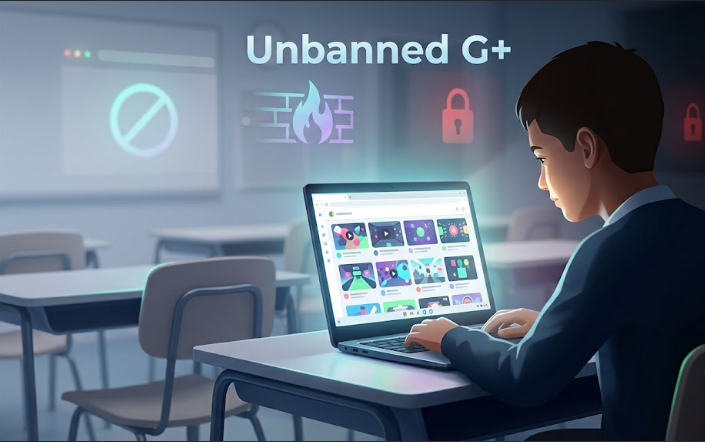
If you’ve heard the phrase “Unbanned G+” in a school hallway, a Discord chat, or a TikTok comment thread, you’ve likely assumed it refers to some official app or hidden Google feature. It doesn’t. Instead, it is part of a wider internet trend built around a simple idea: browser games that still work inside restricted networks. Over time, that idea gained a label, a community, and eventually a myth-like identity that keeps resurfacing under slightly different names.
But “Unbanned G+” is not a product. It is not a platform. And it is not connected to Google+ in any official way. It is a shifting term used to describe a category of unblocked game sites that rely on browser-based technology and widely trusted hosting platforms. Understanding it requires separating what is real from what is internet storytelling.
How “Unbanned G+” Became a Search Term
The search intent behind “Unbanned G+” is fairly consistent across users. People are usually trying to find three things: They want access to games that work on school devices. They want sites that are not blocked by network filters. And they want something that loads quickly without downloads or logins.
This combination of needs explains why the term spread so widely. It sits at the intersection of convenience and restriction. When traditional gaming websites are blocked, users naturally look for alternatives that behave differently. Over time, “Unbanned G+” became shorthand for those alternatives.
The “G+” part likely emerged because many of these game pages are hosted on Google Sites or similar Google-linked infrastructure. That association made the name stick, even though Google itself does not operate or endorse these gaming hubs.
What Unbanned G+ Actually Refers To
Despite its name, Unbanned G+ does not refer to a single website. It refers to a loose network of browser-based gaming portals that are frequently duplicated, mirrored, and reuploaded. These portals typically host HTML5 games that run directly inside a browser tab. No installation is required, and no additional software is needed. A typical page might include racing games, puzzle games, arcade-style shooters, or multiplayer browser titles.
In many cases, these sites are built using simple web frameworks and free hosting services. That makes them easy to replicate, which is part of why they appear under different URLs over time. Recent documentation of similar platforms shows that “unblocked games G+” pages are often described as collections of browser games designed for restricted environments such as schools and workplaces. citeturn0search7 So rather than being a single destination, Unbanned G+ is best understood as a rotating category of websites with a shared purpose.
Why Schools Are the Center of the Trend
The popularity of Unbanned G+ is tightly linked to school networks. Most schools use filtering systems that restrict access to gaming and entertainment sites. These systems categorize websites by domain reputation, content type, and known blacklists. The problem for administrators is that modern browser games no longer require large downloads or obvious gaming domains. They run inside standard web pages, often hosted on platforms that schools already rely on for education.
This creates a structural overlap. The same infrastructure used for classroom tools can also host lightweight games.As a result, students often encounter working game pages during breaks, study gaps, or free periods, even when most gaming websites are blocked.
Why These Sites Are Hard to Eliminate Completely
The persistence of Unbanned G+ style sites is not about technical bypassing tricks. It is about infrastructure dependency Many of these pages are hosted on widely used platforms, including Google-related services. Schools cannot simply block those platforms without disrupting essential academic tools like Google Classroom, Docs, or Drive.
That creates what network engineers sometimes describe as a “shared dependency problem.” The same domain that hosts learning materials may also host unrelated content. On top of that, these sites change frequently. If one page gets blocked, a new mirror often appears under a slightly different URL. This makes long-term blocking a continuous maintenance task rather than a one-time fix.
What Kind of Games Are Found on Unbanned G+ Sites
While the specific catalog varies by site, most Unbanned G+ pages share similar game categories.
Action and shooter games are among the most common, often simplified for browser performance. These include arena-style multiplayer games where players compete in short rounds.
Racing games are another major category. These are typically physics-based and designed for quick sessions rather than long gameplay.
Puzzle games also dominate these platforms. Titles involving number merging, logic challenges, or spatial reasoning are common because they run efficiently on low-powered devices.
There are also platformer and endless-runner games, which rely on simple controls and repetitive mechanics that make them ideal for short breaks.
A consistent feature across all categories is that the games are lightweight and optimized for instant loading in Chrome.
The Role of HTML5 in Making It Possible
Most Unbanned G+ games are built using HTML5 and JavaScript. This is important because it removes the need for plugins like Flash, which were once common in browser gaming but are now obsolete. HTML5 allows games to run natively inside the browser. That means graphics, physics, and input handling are all processed directly by the device without external software.
This design is what makes these games compatible with school Chromebooks, which often have limited installation permissions. It also explains why these games are so fast to load. They rely on small asset files and browser-native rendering instead of large executables.
Safety Considerations and Real Risks
From a security standpoint, Unbanned G+ sites are not inherently dangerous in terms of malware installation. Since everything runs inside the browser, there is no direct software installation process in most cases. However, that does not mean all sites are safe.
The primary risks come from advertising networks and cloned pages. Some mirror sites include aggressive ads or misleading prompts that encourage users to click downloads or enter personal information. The most common safety issues include fake buttons, redirect loops, and phishing-style pages that imitate login screens. Because there is no central authority managing these sites, quality varies widely.
Unbanned G+ vs Traditional Unblocked Game Sites
Traditional unblocked game websites are usually centralized platforms with large libraries and consistent branding. They are easier to identify and therefore easier for network filters to block. Unbanned G+ style sites behave differently. They are decentralized, frequently duplicated, and often hosted on trusted domains. This makes them more resilient in restricted environments, but also less stable. In practice, users often move between both types depending on availability. One may work on a given day while the other is blocked or offline.
Why the Term Keeps Evolving
One of the most interesting aspects of Unbanned G+ is that it is not fixed. It evolves with each wave of filtering updates and each new hosting workaround. As schools update their network controls, new mirror sites appear. As those mirrors get blocked, new versions emerge again. The term itself becomes a catch-all label for whatever is currently accessible. This cycle is what keeps the phrase alive in search trends. It is less about a specific platform and more about an ongoing adaptation process.
Misunderstandings Around “Unbanned G+”
There are several common misunderstandings worth addressing. Some users believe it is an official Google product. It is not. Others think it is a single website that can be bookmarked permanently. It is not stable enough for that. Another misconception is that it guarantees access on all school networks. In reality, access depends entirely on the filtering system in place. The most accurate way to describe it is as a temporary access layer to browser games, not a fixed service.
The Bigger Picture Behind the Trend
Unbanned G+ reflects a broader pattern in digital behavior. When access is restricted, users look for alternative paths. When those paths are blocked, new ones appear. This is not unique to gaming. It appears in streaming, social media, and other content categories as well. In that sense, Unbanned G+ is less about games and more about how the modern web adapts under constraint.
Conclusion
Unbanned G+ is not a single destination but a label that reflects a larger internet behavior pattern. It describes how browser-based games adapt to restricted networks and how users continuously search for accessible entertainment. What makes the term persistent is not the technology itself, but the cycle behind it. Sites appear, get blocked, and reappear in new forms. The name stays the same even when the infrastructure changes completely. As long as browser games remain lightweight, widely distributed, and easy to host, the idea behind Unbanned G+ will continue to evolve—quietly shifting with every new version of the open web.