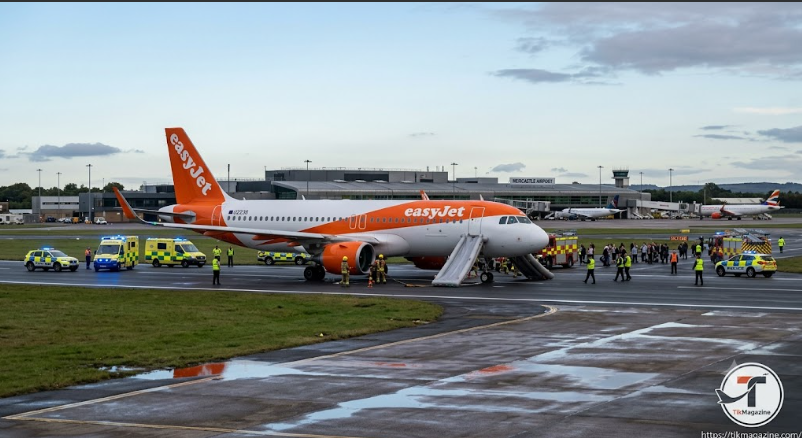
A routine European flight from Copenhagen to Manchester turned into an unexpected mid-air diversion when easyJet flight U2238 was forced to land in Newcastle after a passenger suffered a serious medical emergency onboard. What began as an ordinary short-haul journey over the North Sea quickly shifted into a coordinated aviation response involving pilots, cabin crew, air traffic controllers, and emergency medical teams on the ground.
For passengers, it was a sudden disruption. For the crew, it was a textbook application of aviation safety procedures designed to prioritize human life above schedule, cost, or convenience. The aircraft landed safely, medical assistance was provided immediately, and the flight later continued its journey to Manchester once the situation was under control.
This incident, while unsettling in the moment, reflects how modern aviation systems are built to handle precisely these types of emergencies.
A routine flight that changed over the North Sea
easyJet flight U2238 was operating a scheduled service from Copenhagen Airport to Manchester Airport, a well-travelled route across northern Europe. The flight typically lasts just over two hours and is commonly used by both business and leisure passengers.
According to aviation tracking data and subsequent reporting, the flight departed Copenhagen and proceeded normally during its initial climb and cruise phase. Conditions were stable, and there were no indications of mechanical issues or operational concerns with the aircraft.
However, somewhere over the North Sea, the situation changed when a passenger onboard became seriously unwell. The exact medical condition has not been publicly disclosed, which is standard practice due to privacy laws and airline confidentiality rules.
What is confirmed is that the situation required immediate attention and could not safely be managed until the aircraft reached Manchester.
How cabin crew respond when a medical emergency begins
When a passenger falls ill in flight, cabin crew follow strict procedures designed by aviation regulators and airline medical advisors. These procedures are consistent across most European carriers, including easyJet.
The first step is assessment. Cabin crew are trained in basic emergency care and carry onboard medical kits that include equipment such as oxygen, first aid supplies, and automated external defibrillators.
If a situation appears serious, crew typically request assistance from any medically trained passengers onboard. At the same time, they communicate with the cockpit crew and airline medical support teams on the ground.
In the case of flight U2238, the situation escalated to the point where continuing to Manchester was no longer the safest option. That decision was made in the cockpit after consultation with available medical guidance and operational factors.
At that stage, the aircraft crew initiated a diversion.
Why Newcastle was chosen instead of Manchester
One of the most common questions surrounding this incident is why the aircraft diverted to Newcastle instead of continuing to its planned destination of Manchester.
The answer lies in geography, safety, and timing.
At the moment the emergency was declared, the aircraft was positioned over the North Sea, closer to northeast England than to Manchester. Newcastle Airport was the nearest suitable airport that could safely accommodate the aircraft and provide immediate emergency medical response.
Diversion decisions in aviation are never based on a single factor. Pilots must consider:
- Distance to nearby airports
- Remaining fuel and flight time
- Weather conditions
- Runway length and airport capability
- Availability of emergency medical services
- Air traffic congestion
Newcastle met all of these requirements and allowed for the fastest safe landing option.
Air traffic control cleared the aircraft for an expedited descent, and emergency services were placed on standby before landing. This ensured that medical support would be available the moment the aircraft arrived.
The emergency declaration and cockpit response
During serious in-flight incidents, pilots may declare a general emergency using the internationally recognized transponder code “7700.” This alerts all nearby air traffic control units that the aircraft requires immediate priority handling.
While not every detail of flight U2238’s cockpit communications has been publicly released, multiple reports confirm that the aircraft was treated as a priority case during its diversion.
Once an emergency is declared, the aircraft effectively moves to the top of the landing queue. Other flights may be placed in holding patterns or rerouted slightly to ensure a clear approach path.
This level of coordination is routine in aviation and is designed to minimize risk during time-sensitive situations.
Inside the cabin during the diversion
For passengers onboard, a diversion can feel sudden and disorienting. However, cabin crew are trained to manage communication carefully to avoid panic.
Passengers are typically informed that the aircraft is diverting for “operational reasons” or a “passenger welfare issue,” terms commonly used when medical privacy must be protected.
In this case, the situation was handled calmly according to standard procedures. Crew members ensured that the ill passenger received assistance while also preparing the cabin for landing.
Seats are secured, tray tables stowed, and passengers are instructed to remain seated with seatbelts fastened. These steps ensure safety during descent and landing.
Even though diversions are not everyday events for passengers, they are routine from an operational standpoint for airlines.
Safe landing at Newcastle Airport
The aircraft landed safely at Newcastle Airport without further incident. Emergency medical teams were already waiting on the ground, positioned based on advance coordination between air traffic control and airport services.
Once the aircraft came to a stop, medical personnel boarded to assess the passenger who had fallen ill during the flight. The individual was then transferred into the care of emergency services for further treatment.
The airline has not released additional medical details, which is standard practice and reflects both privacy regulations and respect for the individual involved.
No injuries were reported among other passengers or crew.
What happens to the flight after a diversion
After the emergency was resolved on the ground, the aircraft remained serviceable and was cleared to continue its journey.
This is an important detail in understanding how airline operations work. A medical diversion does not necessarily mean the aircraft itself is grounded. Once safety checks are completed and crew duty limits are assessed, the flight may resume.
In this case, flight U2238 continued to Manchester after the stop in Newcastle, allowing passengers to complete their journey with a delay.
While inconvenient, this is considered the most efficient outcome once the emergency is resolved.
How common medical diversions are in aviation
Medical diversions are one of the most frequent reasons for unscheduled landings in commercial aviation. Although they attract attention when they occur, they represent a small but consistent part of airline operations.
Aviation safety research shows that onboard medical incidents occur regularly across global flights, ranging from mild issues such as fainting or dehydration to more serious cardiac or respiratory events.
Only a fraction of these cases result in diversions, but when they do, pilots are required to act decisively.
The priority is always the same: get the passenger to medical care as quickly and safely as possible.
Why aviation systems prioritize safety over schedule
Incidents like the easyJet U2238 diversion highlight a core principle of commercial aviation: schedule disruption is acceptable when compared to potential risk to human life.
Modern aviation is built around redundancy, coordination, and rapid decision-making. Pilots are empowered to make diversion decisions without waiting for lengthy approval processes when health or safety is at risk.
Air traffic control systems across Europe are designed to support these decisions instantly, clearing airspace and prioritizing emergency aircraft.
From a systems perspective, the goal is not to avoid disruption entirely but to manage it in a way that protects passengers and crew.
Passenger experience and perception
For passengers, diversions often feel more dramatic than they actually are. The change in destination, the descent to an unfamiliar airport, and the presence of emergency vehicles can understandably create concern.
However, aviation professionals emphasize that medical diversions are among the safest procedures in commercial flight operations.
The presence of emergency responders at landing is not an indication of danger to the aircraft itself, but rather preparedness for the medical situation that triggered the diversion.
In this case, the safe landing and continued flight completion reflect that the system worked as intended.
What this incident tells us about modern air travel
The easyJet U2238 diversion is not an unusual aviation event, but it is a clear example of how multiple systems work together under pressure.
From cabin crew medical training to cockpit decision-making, from air traffic control coordination to airport emergency response, every layer of the aviation network played a role in ensuring a safe outcome.
While passengers experienced disruption, the underlying system functioned precisely as designed.
Frequently Asked Questions
What caused easyJet flight U2238 to divert to Newcastle?
The flight diverted due to a passenger experiencing a serious medical emergency onboard that required urgent care.
Was there anything wrong with the aircraft?
No technical issues were reported. The diversion was purely for medical reasons.
Why didn’t the flight continue directly to Manchester?
Newcastle was the closest suitable airport at the time, allowing faster access to emergency medical services.
Did the aircraft land safely?
Yes, the aircraft landed safely at Newcastle Airport with emergency services ready on arrival.
What happened to the passenger who became ill?
The passenger was transferred to medical professionals after landing. Their condition has not been publicly disclosed.
Did the flight continue after the stop?
Yes, after the situation was resolved and safety checks were completed, the flight continued to Manchester.
Are medical diversions common?
Yes, they are one of the more common reasons for unscheduled landings in commercial aviation.
Conclusion
The diversion of easyJet flight U2238 to Newcastle demonstrates how aviation systems are designed to respond quickly and effectively when a passenger’s health is at risk. While the experience may have been unexpected for those onboard, the outcome reflects a coordinated safety structure working exactly as intended.
From cockpit decisions to ground medical response, every step prioritized human life over operational convenience. Once the situation was stabilized, the flight resumed its journey, underscoring the resilience and flexibility built into modern air travel.
Events like this rarely make headlines for long, but they offer a clear reminder: in aviation, safety is not a slogan—it is a system in constant motion.