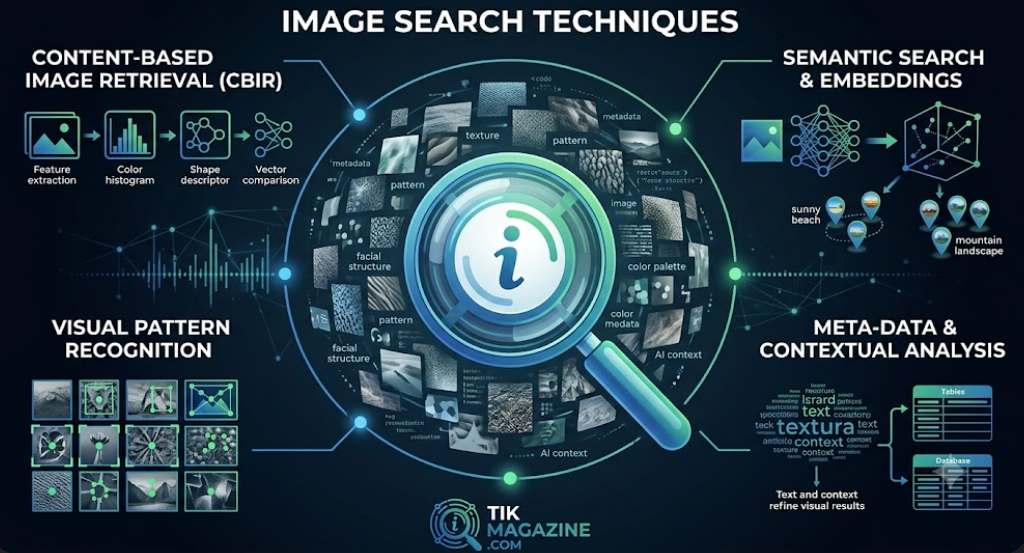
Most people think image search is simple. You type a phrase, press enter, and scroll through pictures. Or you upload a photo and instantly get matches. But behind that simple experience is a layered system built from indexing rules, computer vision models, and increasingly, AI systems that try to understand what is actually inside an image.
The interesting part is not just that image search works, but how many different systems are working at the same time to make it feel effortless. Some focus on text, some on pixels, some on objects, and some on meaning. Modern search engines combine all of them because no single method is strong enough on its own.
To understand image search properly, you need to see it as a stack of techniques rather than one tool. Each layer solves a different problem: finding exact matches, recognizing objects, understanding similarity, or interpreting context. Once you break it down this way, the whole system starts to make sens
Keyword-Based Image Search (Metadata-Based Retrieval)
The oldest and still most widely used method is keyword-based image search. This is what happens when you type something like “mountain sunset” or “red running shoes” into a search engine.
The system does not actually “look” at images in this case. Instead, it relies on text associated with the image. That includes file names, alt text written by website owners, captions, and the surrounding content on the webpage. If those signals match your query, the image gets included in results.
This approach works well when images are properly labeled. For example, stock photo websites often use structured descriptions, which makes them easy to index and retrieve. But the weakness becomes obvious when metadata is missing or misleading. A beautiful image with no description may never appear in search results at all.
So keyword-based search is fast and scalable, but it is not visual intelligence. It is text matching applied to images.
Reverse Image Search (Searching with an Image Instead of Words)
Reverse image search flips the entire idea of search. Instead of describing what you want, you provide the image itself.
The system then analyzes the image and generates a kind of digital fingerprint. This fingerprint is not a simple file match. It is a mathematical representation of visual features such as edges, color patterns, shapes, and spatial relationships.
That representation is compared against millions or billions of other images in an index. If similar patterns exist, the system returns matches.
This method is especially useful when you want to:
- Find the original source of an image
- Check if an image has been reused elsewhere
- Identify products or objects
- Detect edited or cropped versions
But it also has limits. If an image is new, rare, or not widely indexed, reverse search may return very little. It also struggles when images are heavily altered or low quality.
Still, it remains one of the most practical tools for verification and discovery.
Content-Based Image Retrieval (CBIR)
Content-Based Image Retrieval is the technical backbone of modern visual search. Instead of relying on text or filenames, it analyzes the actual content of an image.
The process usually starts by breaking the image into measurable features. Older systems used handcrafted features like color histograms and texture maps. Modern systems rely more on neural networks that convert images into feature vectors automatically.
These feature vectors represent the image in a mathematical space. Images with similar content end up closer together in that space, even if they look different at a pixel level.
This allows systems to search based on similarity rather than exact matches. CBIR is used in areas where labeling is difficult or impossible, such as medical scans, satellite imagery, and large digital archives.
However, CBIR has an important limitation: similarity is not always meaning. Two images might share visual patterns but represent completely different concepts.
Visual Similarity Search
Visual similarity search builds on CBIR but focuses more on user experience. The goal is not to find the exact same image, but images that feel similar in style, structure, or composition.
For example, if you search for a modern kitchen design, you will not get duplicates of one photo. Instead, you get a variety of kitchens that share similar aesthetics—white cabinets, clean lines, minimal lighting, or open layouts.
This is possible because modern systems use deep learning models trained on large datasets. These models learn abstract relationships between images instead of just matching colors or edges.
This technique is widely used in design platforms, fashion discovery tools, and visual inspiration apps. It works well when users are exploring ideas rather than searching for something specific.
The tradeoff is precision. You gain variety, but you lose strict accuracy.
Object and Product Recognition in Images
Object recognition brings image search closer to human perception. Instead of treating the image as a whole, the system identifies individual objects inside it.
For example, an image might contain a chair, a table, and a lamp. Object recognition models detect each of these separately and classify them. Once identified, the system can connect those objects to product databases or similar items.
This is the foundation of visual shopping. When you take a photo of a sneaker or furniture item, the system can suggest similar products available online.
These systems are trained on large datasets where objects are labeled and categorized. They learn to recognize patterns even when objects are partially hidden or viewed from different angles.
Still, performance is not perfect. Unusual lighting, cluttered scenes, or uncommon objects can reduce accuracy significantly.
Metadata and Image Tagging Systems
Even in modern AI-driven search, metadata still plays an important role. It provides structure and context that visual models cannot always infer.
Metadata includes things like file names, image descriptions, upload dates, and embedded camera data. Some systems also extract text directly from images using optical character recognition.
This information helps search engines organize content, filter results, and improve ranking accuracy.
The problem is reliability. Metadata depends entirely on how the image was uploaded or labeled. If that information is missing or incorrect, the system has less to work with.
That is why metadata is usually combined with visual analysis rather than used alone.
Context-Based Image Understanding
Context changes everything in image search. The same image can mean different things depending on where it appears and what surrounds it.
A picture of a jaguar, for example, could refer to an animal in a wildlife article or a luxury car in an automotive review. Without context, the system might not know which meaning is correct.
Context-based systems look at surrounding text, page structure, headings, and related content. They use this information to adjust ranking and interpretation.
This is especially important in news, education, and research environments where accuracy depends on meaning, not just appearance.
Context also helps reduce ambiguity in cases where images are visually similar but conceptually different.
AI-Powered Multimodal Image Search
The most advanced stage of image search combines text and image understanding in a single system. These are called multimodal systems.
Instead of treating text and images separately, these models process both together. You can upload an image and refine your search using natural language. For example, you might say “show cheaper versions of this” or “find something similar but more minimal.”
These systems break down images into components, interpret objects and relationships, and then adjust results based on the user’s intent.
This is a major shift because search is no longer just about matching data. It is about understanding intent.
However, these systems are still evolving. They can misinterpret context or over-generalize results. But they are quickly becoming the standard in modern search tools.
Hybrid Image Search Systems
In real-world applications, no single method is used alone. Search engines combine multiple techniques into one pipeline.
A typical system might use:
- Metadata for initial filtering
- CBIR for visual similarity
- Object recognition for identification
- AI models for ranking and intent understanding
Each layer improves the others. Metadata narrows the search space, visual models analyze content, and AI systems refine results based on user behavior.
This layered structure is why modern image search feels fast and accurate despite working with massive datasets.
It also explains why different platforms can produce different results for the same query. Each system weights these layers differently.
Common Misunderstandings About Image Search
One common misunderstanding is that image search works like a simple lookup system. In reality, it is a complex ranking process involving multiple stages.
Another misconception is that reverse image search always finds the original source. It only finds images within its indexed coverage. If an image is not widely distributed online, it may not appear at all.
There is also confusion about AI involvement. Many people assume AI is a new addition, but machine learning has been part of image search ranking for years. The difference now is scale, accuracy, and integration with language models.
Why Image Search Keeps Evolving
The demand for better image search comes from how people use the internet today. Users do not just want to find images. They want to identify objects, verify authenticity, discover products, and explore ideas visually.
That demand pushes search systems to become more intelligent. Instead of matching words or pixels, they now try to interpret meaning.
This evolution is still ongoing. Each improvement brings search closer to human-like understanding, but also introduces new challenges around accuracy and interpretation.
Conclusion
Image search techniques are not a single technology but a combination of multiple systems working together. Some rely on text, some on visual patterns, and others on AI-driven interpretation.
Each method plays a specific role. Keyword search provides structure. Reverse image search supports verification. CBIR handles visual similarity. Object recognition enables identification. Multimodal systems bring everything together into a more flexible experience.
What is changing now is not just how images are found, but how they are understood. Search is moving away from simple matching and toward systems that interpret intent and meaning.
That shift is already shaping how people interact with visual content online, and it will continue to define the next generation of search systems