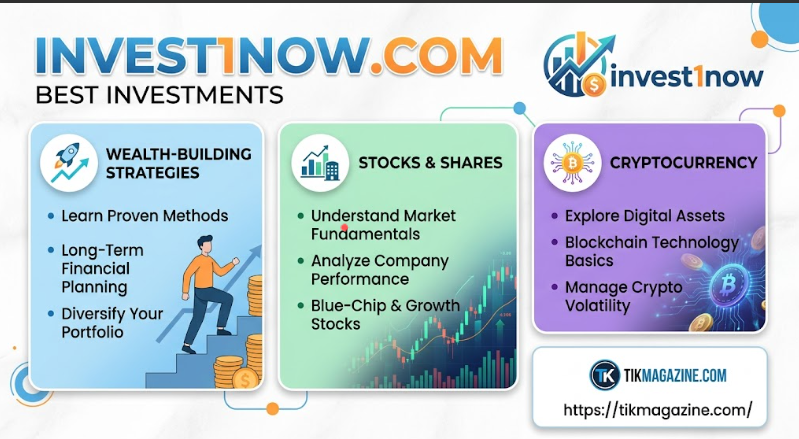
Investing today feels more accessible than ever, but also more confusing. Platforms like invest1now.com often appear in search results promising insights into “best investments,” yet most readers are left with a basic question: what does that actually mean, and how should it guide real financial decisions?
The truth is simple but often overlooked. “Best investments” is not a fixed list of products. It is a moving target shaped by risk tolerance, financial goals, time horizon, and market conditions. What works for one investor may be completely unsuitable for another.
Invest1now.com, like many modern financial content platforms, sits in the educational space. It discusses asset classes such as stocks, ETFs, crypto, and real estate, rather than acting as a direct investment provider. That distinction matters, because it changes how readers should interpret any “investment recommendations” they encounter.
What invest1now.com represents in modern investing content
Invest1now.com is typically understood as a finance-focused informational platform that discusses different investment options and wealth-building strategies. It does not function like a brokerage or trading app where users directly buy assets.
Instead, its role is closer to financial education. It introduces readers to concepts like portfolio diversification, long-term investing, and risk awareness. These topics are widely covered across financial media, from beginner investing blogs to institutional education resources.
The main idea behind platforms like this is accessibility. They simplify financial topics for beginners who may not yet understand how markets work. However, that simplicity also means readers must apply critical thinking before acting on any information.
Stocks as the foundation of most investment portfolios
Stocks remain one of the most widely discussed investment categories in any financial content ecosystem, including invest1now.com-style discussions. A stock represents partial ownership in a company, and its value changes based on company performance and market demand.
For long-term investors, stocks are often considered a core building block of wealth. Historically, equity markets have delivered higher returns than cash savings over long periods, although they also experience short-term volatility.
There are two main types of stock strategies often highlighted in educational content: growth investing and dividend investing. Growth stocks focus on increasing value over time, while dividend stocks provide regular income payouts. What makes stocks essential in most portfolios is not just return potential, but flexibility. Investors can choose conservative blue-chip companies or high-risk emerging businesses depending on their risk appetite.
Index funds and ETFs for simplified investing
One of the most consistently recommended investment types across modern financial education is the index fund or ETF. These instruments allow investors to own a large group of stocks within a single investment. Instead of picking individual companies, an investor might buy an ETF that tracks the S&P 500, which includes hundreds of major U.S. companies. This instantly spreads risk across multiple sectors.
The main advantage of ETFs is simplicity. They reduce the need for constant market monitoring and eliminate the pressure of selecting individual winning stocks. Another important factor is cost. Many index funds have lower fees compared to actively managed funds, which can significantly improve long-term returns. For beginners, ETFs often serve as the “starting point” of investing because they combine diversification, simplicity, and long-term stability.
Real estate investing and property-based wealth
Real estate continues to be one of the most discussed asset classes in platforms like invest1now.com. Property investment is often associated with long-term stability and tangible asset ownership. Direct real estate investment involves buying physical property, renting it out, or selling it at a higher price later. This can generate both rental income and capital appreciation.
However, real estate requires significant capital and active management, which is not practical for everyone. That is where REITs, or Real Estate Investment Trusts, become important. REITs allow investors to gain exposure to property markets without owning physical buildings. They function like stocks but represent ownership in income-generating real estate portfolios. Real estate is attractive because it is often seen as a hedge against inflation. However, it is also sensitive to interest rates and local market conditions.
Cryptocurrency and digital asset exposure
Cryptocurrency is one of the most discussed and controversial investment categories in modern finance. It frequently appears in platforms that discuss digital wealth-building strategies. Bitcoin, Ethereum, and other digital assets are based on blockchain technology and operate independently of traditional banking systems. This decentralized structure is what attracts many investors.
The appeal of crypto lies in its high potential returns and global accessibility. Markets operate 24/7, and entry barriers are relatively low compared to traditional assets. However, volatility is extreme. Prices can rise or fall dramatically in short periods, and regulatory frameworks are still developing in many countries. Because of this, financial educators typically treat crypto as a high-risk asset that should only represent a small portion of a diversified portfolio.
Bonds and fixed-income stability
Bonds are often positioned as the stabilizing force within an investment portfolio. Unlike stocks, bonds provide predictable interest payments over time. When an investor buys a bond, they are essentially lending money to a government or corporation. In return, they receive regular interest and the return of principal at maturity.
Government bonds are generally considered safer than corporate bonds because they are backed by national credit systems. However, they also tend to offer lower returns. Bonds are particularly useful for balancing risk in a portfolio. When stock markets become volatile, bonds often provide more stable performance.
High-yield savings accounts and capital protection
While not traditionally seen as “investments,” high-yield savings accounts play an important role in financial planning. They provide guaranteed returns with minimal risk. These accounts are typically used for emergency funds or short-term financial goals. The main advantage is liquidity, meaning money can be accessed quickly when needed.
Certificates of deposit (CDs) function similarly but often require locking funds for a fixed period in exchange for slightly higher interest rates. Although returns are lower than stocks or real estate, these instruments are essential for financial stability and risk balance.
Risk and diversification in modern investing
One of the strongest messages across financial education platforms is the importance of diversification. No single asset class performs well in all market conditions. Stocks may perform strongly during economic growth, while bonds provide stability during downturns. Real estate can act as a hedge against inflation, while crypto offers speculative growth potential.
A balanced portfolio spreads investments across these categories to reduce the impact of any single market event. Risk tolerance also plays a major role. Younger investors may accept higher volatility for long-term growth, while conservative investors often prioritize capital protection. Understanding risk is more important than chasing returns. Without risk awareness, even strong investments can lead to poor outcomes.
Common misconceptions about “best investments”
Many beginners assume there is a universal list of best investments that applies to everyone. In reality, this is not how financial markets work. Another misconception is that platforms like invest1now.com provide personalized financial advice. In most cases, they offer general educational content rather than tailored recommendations.
Some also believe that higher returns always mean better investments. In reality, higher returns usually come with higher risk, and not every investor is prepared for that tradeoff. Finally, there is often confusion between information and execution. Reading about investments is not the same as actively investing with a strategy.
Building a smart investment strategy
A realistic investment strategy is built on three pillars: stability, growth, and flexibility. Stability comes from assets like bonds and savings accounts. Growth comes from stocks and ETFs. Flexibility comes from keeping some liquid assets available for opportunities or emergencies. This structure allows investors to manage uncertainty while still participating in long-term wealth creation. There is no perfect portfolio. There is only a portfolio that matches your goals, time horizon, and emotional tolerance for risk.
Conclusion
Invest1now.com best investments should not be interpreted as a fixed list of financial products. Instead, they represent a broader overview of modern investing categories used in personal finance education.
Stocks, ETFs, real estate, bonds, savings instruments, and cryptocurrency each play different roles in a portfolio. The real challenge is not identifying one “best” investment, but building a structure that fits personal financial goals. Investing success comes from consistency, risk awareness, and long-term thinking rather than chasing short-term opportunities.