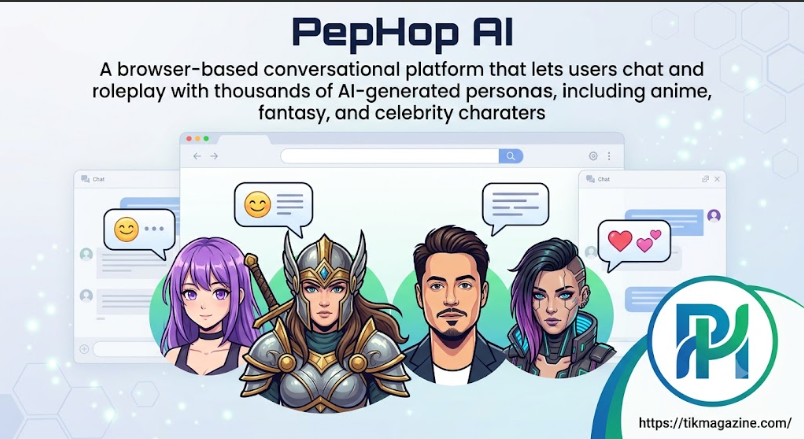
PepHop AI is an AI character chat platform designed for users who want interactive conversations with virtual personalities instead of traditional question-and-answer assistants. It focuses on storytelling, roleplay, and simulated dialogue experiences where each AI character behaves like a distinct personality with its own tone, background, and communication style.
In 2026, platforms like this are gaining attention because users are no longer only looking for productivity tools. They also want entertainment, emotional engagement, and creative interaction. PepHop AI sits directly in that space, offering a browser-based environment where users can chat with AI-generated characters in real time.
What PepHop AI Is and Why It Exists
PepHop AI is built around a simple idea: instead of talking to a general AI assistant, you talk to “characters.” Each character is programmed or trained with a specific personality, tone, and behavior pattern. That means conversations can feel like chatting with a fantasy hero, an anime character, a fictional companion, or a user-designed personality.
The reason platforms like this exist is because AI usage has shifted. Early AI tools were focused on productivity, search, and automation. But user demand has expanded into entertainment and emotional simulation. People now use AI not just for answers, but for interaction and creative engagement. PepHop AI fits into this category of character-based conversational AI, where storytelling becomes the primary function instead of task completion.
How PepHop AI Works in Practice
PepHop AI runs in a web browser, which makes it accessible without downloads or installation. A user creates an account, chooses a character, and begins chatting immediately.
Each message is processed through a language model that generates responses based on:
- the character’s personality description
- previous conversation context
- user input style and tone
The result is a dynamic conversation that evolves over time. Instead of static replies, the system tries to maintain a consistent personality voice for each character. In simple terms, it works like this: you type a message, the AI interprets it through the lens of the chosen character, and responds in a way that matches that personality.
Character System and Customization
One of the most important parts of PepHop AI is its character system. The platform does not rely on a single AI identity. Instead, it allows thousands of different personas to exist at the same time.
These characters typically include:
- fantasy characters such as warriors, mages, or mythical beings
- anime-inspired personalities
- fictional romantic or companion-style characters
- user-generated original characters
Users are not limited to existing options. They can also create their own characters by defining traits such as:
- personality style (calm, aggressive, playful, serious)
- backstory or fictional history
- speaking tone and behavior patterns
- relationship style toward the user
This customization is one of the reasons PepHop AI attracts creative users and roleplay communities. It turns AI interaction into a form of interactive writing.
Conversation Style and Experience
The conversation style on PepHop AI is different from standard AI chat systems. Instead of focusing on accuracy or factual correctness, the platform focuses on consistency of personality and narrative flow. A conversation can evolve into a story-like exchange. For example, a user might start with a simple greeting, and over time the interaction becomes a roleplay scenario with evolving context.
This makes the experience feel less like using software and more like participating in a dialogue-driven story. However, this also means the system is not designed for factual tasks like research, technical explanations, or professional problem-solving. It is built for immersion, not precision.
Why PepHop AI Has Become Popular
The popularity of PepHop AI is tied to a broader shift in how people interact with AI systems. First, users want personalization. Instead of generic answers, they want responses shaped by personality and context. Character-based AI delivers that experience.
Second, there is growing interest in AI-driven storytelling. Writers, gamers, and creative users use platforms like this to explore ideas, dialogue, and character development. Third, accessibility matters. Because PepHop AI is browser-based, it removes barriers like installation, configuration, or technical setup. Together, these factors create a platform that feels easy to use but also highly flexible in how conversations unfold.
Strengths of PepHop AI
PepHop AI has several strengths that explain its growing user base. One major strength is variety. The platform supports a large number of characters across different categories. This gives users freedom to explore different interaction styles without being locked into a single experience.
Another strength is customization. Users can design their own characters, which adds a creative layer that goes beyond simple chatting. This is especially appealing for writers and roleplay communities.
Ease of access is also important. Since it runs in a browser, users can start immediately without downloading apps or installing software. Finally, the conversational style is engaging. The focus on personality-driven responses makes interactions feel more dynamic than traditional chatbot systems.
Limitations Users Should Understand
Despite its appeal, PepHop AI is not a perfect system. It has clear limitations that users should understand before relying on it heavily. One limitation is consistency over long conversations. Like many AI systems, it may lose track of earlier context when chats become very long or complex. This can affect storytelling continuity.
Another limitation is dependency on subscription models. While basic access may be available, more advanced features are typically restricted to paid plans. This can limit the experience for free users. There is also the broader issue of unpredictability. Because characters are user-generated and AI-driven, quality can vary significantly depending on how well a character is designed or maintained. These limitations do not make the platform unusable, but they do define its boundaries clearly.
Who PepHop AI Is Actually For
PepHop AI is not designed for everyone. It is best suited for users who want interactive, personality-driven experiences rather than structured productivity tools.
Its main user groups include:
- creative writers exploring dialogue and storytelling
- roleplay communities interested in character interaction
- users looking for entertainment-based AI chat
- individuals interested in fictional companion-style conversations
It is not intended for academic research, business use, or technical problem-solving. Understanding this distinction is important because it shapes expectations. Users who approach it as a storytelling tool tend to have a better experience than those expecting a general AI assistant.
How It Fits Into the AI Trend
PepHop AI reflects a larger shift in the AI industry. The focus is moving beyond simple question-answer systems toward experience-based AI interaction. Instead of asking “what can AI do for me,” users are increasingly asking “what kind of experience can I have with AI.”
This includes:
- character chat platforms
- AI companions
- story-driven chat systems
- personality-based virtual agents
PepHop AI sits firmly in this category, where emotional engagement and narrative immersion are central.
Risks and Considerations
Like any AI platform, PepHop AI comes with considerations Users should be aware that AI-generated characters are not real individuals and should not be treated as replacements for real human relationships or professional guidance.
Privacy is also a general consideration in any web-based AI system. Users should avoid sharing sensitive personal information during chats. Finally, expectations should remain realistic. The system is designed for entertainment, not accuracy or professional reliability.
Conclusion
PepHop AI represents a growing direction in artificial intelligence where interaction matters as much as information. Instead of focusing on productivity or data, it focuses on personality, dialogue, and storytelling. Its strengths lie in customization, character variety, and ease of access. Its limitations are found in consistency, subscription dependency, and its narrow focus on entertainment.
As AI continues to evolve, platforms like PepHop AI show that users are not just looking for answers anymore. They are looking for experiences that feel interactive, personal, and creatively open-ended. The future of AI will not be defined only by what machines can say—but also by how they can make conversations feel.